


From wood to charcoal: understanding wood anatomy and fire signatures in Australian archaeology

Chae Byrne and Emilie Dotte-Sarout
The DTTS Fire Team, part of Research Node 2 Fire, Plants and Water, is applying anthracology (the study of wood charcoal) and wood anatomy to understand the natural processes that can affect charcoal and wooden artefacts. The goal of this study is to improve how we interpret these materials in archaeological sites, using reference collections and a series of controlled anthracological experiments. Here we focus on an important step that has previously been overlooked in Australian anthracology - interpreting wood anatomy before it has been charred!
Exploring desert country - stunning vistas, meaningful conversations, and lots of wood!
Anthracologists explore charcoal. By hand-splitting charcoal we can study the internal anatomical features that allow us to identify species - microscopic features which are preserved, or fossilised, during carbonisation.
Carbonisation (or thermal decomposition) occurs when wood is heated up in an oxygen-poor environment and transformed into charcoal. During this process the moisture and volatile compounds in the wood are removed, leaving behind the black, stable, and porous carbon-rich material we know as charcoal. Importantly, the original cellular structure of the wood is largely preserved, allowing species identification in archaeological contexts.
Left and centre - wood samples are catalogued in the UWA Archaeobotany Lab before being charred in a specially built kiln and mounted as charcoal sections on glass slides.
Carbonisation is not without distortion, however! The loss of moisture combined with exposure to heat can cause shrinking, cracking, and subtle alterations to the wood's structure. Our study aims to better understand these transformations and how they are affected by charring conditions and different woody species. We're also building a strong reference collection of uncharred wood, essential for improving the identification of unburnt wood in archaeological records - like wooden artefacts!
To do this, we use a microtome. The UWA Archaeobotany Lab houses a customised WSL Lab Microtome designed to cut extremely thin sections of wood for transparent slide analysis.
Charcoal samples are thinly sliced using the Microtome and undergo different stages of treatment until the anatomy is visible under microscope. Right - students from Wiluna Remote Community School explored our anthracology collection during a visit last year!
Starting with a small sample from our reference collection (approximately 1cm3), the wood is carefully prepared and placed into the microtome. The instrument slices the sample into ultra-thin sections which then undergo a series of chemical treatments, are stained, and then mounted onto glass slides. The result is a semi-transparent preparation that allows us to observe the anatomical features of the wood under a transmitted light microscope.
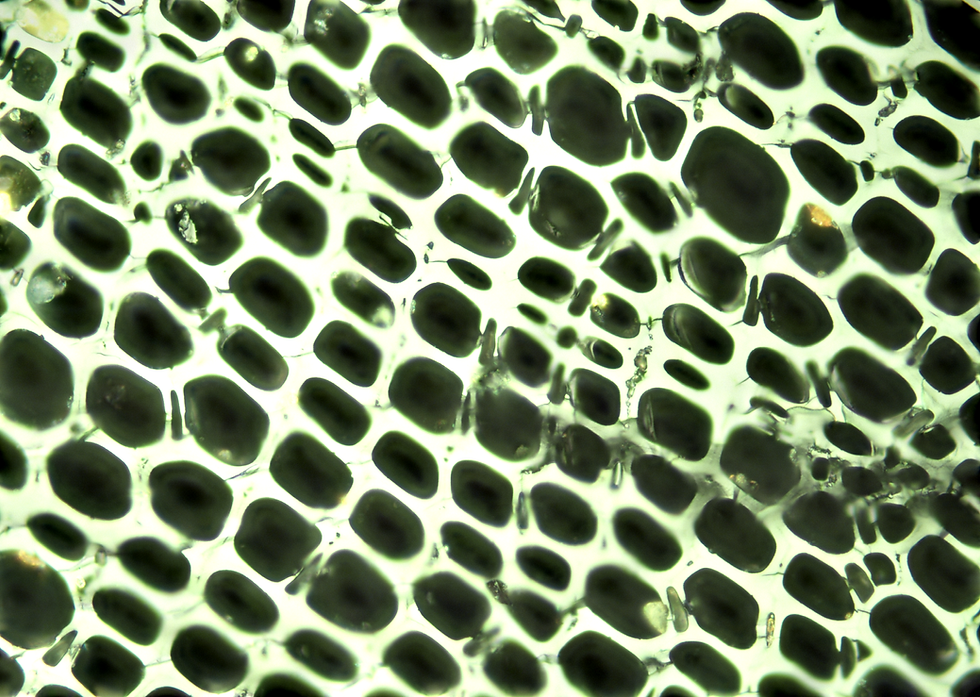
Callitris sp. under the Reflected Light Microscope (x20).
Samples we've produced using this methodology are now being compared to charred samples from archaeological sites across our research area, providing a crucial baseline for comparing modern wood anatomy to its charred archaeological counterparts.
We look forward to sharing some results soon!
Acknowledgements
We want to give a big shout out to the wider Desert to the Sea team, and an even bigger thanks to project partners Murujuga Aboriginal Corporation (MAC), Mungarlu Ngurrarankatja Rirraunkaja Aboriginal Corporation (MNR) and Jamukurnu Yapalikurnu Aboriginal Corporation (JYAC) for their time, collaboration, and guidance on Country!


Comments